
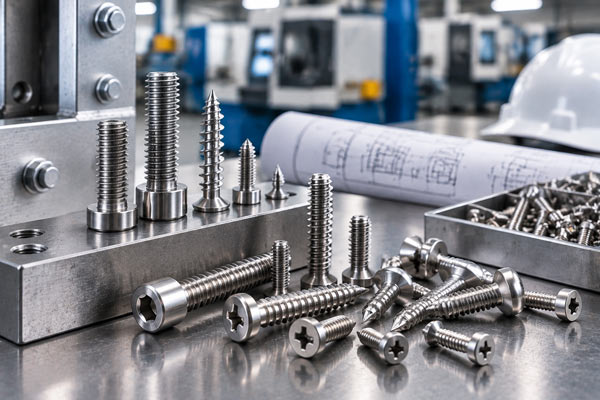
Types of Stainless Steel Screws
When designing and assembling industrial equipment, machinery, or structural elements, engineers and procurement specialists know that the smallest components often dictate overall system reliability. Among these, Stainless Steel (SS) Screws play a foundational role in providing secure, long-lasting, and corrosion-resistant joints.
At ssboltsnut.com, we specialize in delivering high-grade industrial fasteners tailored to meet rigorous performance benchmarks. In this guide, we break down everything you need to know about stainless steel screws, material grades, and how to select the right fit for your application.
Why Choose Stainless Steel for Fasteners?
Unlike standard carbon steel, which is prone to oxidation and environmental degradation over time, stainless steel contains a minimum of 10.5% chromium. When exposed to oxygen, chromium forms a microscopic, self-healing passive layer on the surface of the screw. This layer prevents moisture and chemical agents from reaching the core material, offering vital benefits:
- Superior Corrosion Resistance: Essential for outdoor, marine, and chemically active environments.
- High Tensile Strength: Maintains structural integrity under continuous load and fluctuating temperatures.
- Aesthetic and Hygienic Appeal: Resistant to staining and easy to clean, making it ideal for food processing, pharmaceutical, and architectural applications.
- Long Lifecycle: Drastically reduces maintenance, replacement overhead, and system downtime.
Common Types of SS Screws and Their Applications
Different assembly requirements call for specialized head types, thread geometries, and driving mechanisms:
- Machine Screws: Designed to fasten into tapped holes or work alongside precision nuts within machinery sub-assemblies and electrical panels. Common variants include Pan Phillips, Socket Head Cap, and Slotted heads.
- Self-Tapping Screws: Engineered to form their own mating threads as they are driven into pre-drilled holes in sheet metal, plastics, or composite materials.
- Self-Drilling (Tek) Screws: Featuring a drill-bit point, these screws drill their own holes and tap threads in a single operational step—widely utilized in HVAC, metal framing, and roofing.
- Grub Screws (Set Screws): Headless fasteners threaded along their entire length, primarily used to secure pulleys, gears, or handles onto rotating shafts.
Key Material Grades: 304 vs. 316
Selecting the correct alloy grade ensures your fasteners withstand operating conditions without premature failure.
Grade 304 (A2 Stainless Steel)
- Composition: ~18% Chromium and ~8% Nickel.
- Best Suited For: General industrial applications, architectural hardware, food processing equipment, and indoor environments.
- Key Advantage: Offers an optimal balance of cost, formability, and reliable baseline corrosion resistance.
Grade 316 (A4 Stainless Steel)
- Composition: Chromium, Nickel, plus 2% to 3% Molybdenum.
- Best Suited For: Marine environments, chemical processing plants, coastal installations, and high-salinity areas.
- Key Advantage: The addition of molybdenum provides exceptional resistance against pitting, chlorides, and aggressive chemical solutions.
Benefits of Using Stainless Steel Washers
SS Screws as Part of a Complete Stainless Steel Fastening System
Many industrial applications use a combination of stainless steel fastening products.
These may include:
SS Screws + SS Nuts + SS Washers + SS Bolts + SS Studs
Using compatible fasteners helps maintain consistency across the complete assembly.
However, material grade, dimensions, thread specifications, load requirements, and environmental conditions should always be checked before installation.
Conclusion
SS Screws are essential fastening components for modern industrial and engineering applications. Their corrosion resistance, durability, clean finish, and availability in different designs make them suitable for machinery, construction, automotive, electrical, fabrication, chemical, pharmaceutical, food processing, and many other industries.
Options such as SS Machine Screws, SS Self Tapping Screws, SS Allen Screws, SS Countersunk Screws, SS 304 Screws, and SS 316 Screws allow buyers to select products according to their specific requirements.
For reliable fastening performance, always choose the correct screw type, size, thread, head style, stainless steel grade, and dimensional standard according to the application.
Frequently Asked Questions
SS Screws are threaded fastening components manufactured from stainless steel and used to join two or more components securely.
They are commonly used in machinery, construction, automotive components, electrical equipment, furniture, fabrication, chemical plants, food machinery, and general engineering.
Common types include SS machine screws, self-tapping screws, Allen screws, countersunk screws, and other application-specific screw designs.
SS 304 is widely used for general industrial applications, while SS 316 is commonly selected for applications requiring greater resistance to certain corrosive or marine environments.
Yes, suitable stainless steel grades can be used for outdoor applications. The grade should be selected according to moisture, weather, chemicals, and environmental exposure.
SS self-tapping screws are designed to create or form threads in suitable materials during installation.
SS machine screws are commonly used in machinery, electrical panels, instruments, automotive components, and engineering equipment.
Check the required diameter, length, thread, head type, drive type, material grade, application, and dimensional standard.
Yes. Stainless steel screws are commonly available in different diameters, lengths, thread types, head styles, and grades.
Industrial buyers can source SS screws from stainless steel fastener manufacturers and suppliers serving Ahmedabad, Gujarat, and other parts of India according to their required specifications.